Local sidereal time
Research shows remote viewing ability can increase by 340-450% during a specific window of sidereal time. Your orientation relative to the galaxy may matter.
James Spottiswoode analyzed 20 years of data and found psi performance peaks when the galactic core rises on your eastern horizon.
What is local sidereal time?
Most people think about time using the sun. Solar time divides the day based on Earth's rotation relative to the sun: sunrise, noon, sunset. But astronomers use a different clock.
Sidereal time measures Earth's rotation relative to distant stars. One sidereal day is about 23 hours and 56 minutes, four minutes shorter than a solar day. That difference accumulates. Over the course of a year, the night sky shifts across all 24 hours of the clock.
Local sidereal time tells you which portion of the celestial sphere is directly overhead at your longitude. At 0 hours LST, the First Point of Aries (the vernal equinox marker) crosses your local meridian. At 13.5 hours LST, Sagittarius A — the galactic core — rises on your eastern horizon.
LST is location-specific. Your local sidereal time depends on your longitude. Two people at different longitudes will have different LST values at the same solar clock time.
The Spottiswoode research
In 1997, James Spottiswoode, a parapsychologist who worked at the Stanford Research Institute, published a surprising finding. He analyzed 1,524 trials from 22 different remote viewing and ESP studies spanning 20 years.
The data showed a clear correlation between local sidereal time and performance on anomalous cognition tasks (ESP, remote viewing, telepathy). Effect sizes were not consistent across all hours of the sidereal day.
Performance peaked sharply around 13.5 hours LST.
1,524 trials
20 years of data across 22 studies
340-450% increase
Effect size at peak window
Psi ability vs local sidereal time
Spottiswoode's data shows a dramatic enhancement in remote viewing performance during a narrow window. The peak occurs at approximately 13.5 hours LST, when the galactic core crosses the eastern horizon.
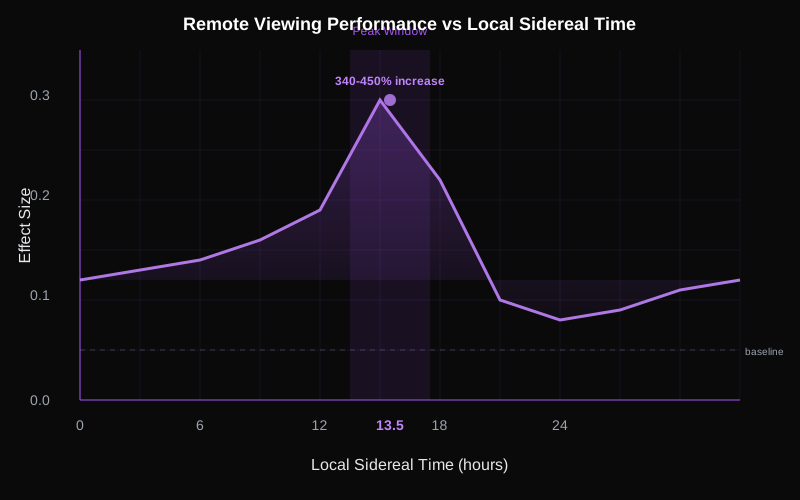
Effect size (deviation from chance) plotted against local sidereal time. Data from Spottiswoode (1997).
The 13.5 hour LST window
The peak performance window spans approximately 12:45 to 14:15 hours LST, lasting about three and a half hours. During this window, remote viewing effect sizes increase dramatically compared to baseline.
Initial study
1,468 trials showed a 340% increase in effect size for trials within 1 hour of 13.5h LST (p = 0.001)
Confirmation study
Independent database of 1,015 trials showed a 450% increase in effect size at 13.5h LST (p = 0.05)
These findings have been replicated across multiple independent datasets, making the LST correlation one of the most robust effects in psi research.
The galactic core hypothesis
At 13.5 hours LST, Sagittarius A — the supermassive black hole at the center of our galaxy — rises on the eastern horizon. Spottiswoode theorized that cosmic radiation from the galactic core region may enhance psi abilities when it enters Earth's atmosphere at this specific angle.
When the galactic core is rising, cosmic radiation travels through the longest possible path in the atmosphere, entering tangentially rather than from overhead. This may create conditions that support anomalous cognition.
Conversely, remote viewing performance was poorest around 18 hours LST, when the galactic core reaches its highest point above the southern horizon.
Note: The exact mechanism is not yet understood. This is a correlational finding, not a proven causal explanation. But the correlation itself is statistically significant and has been independently confirmed.
Solar time vs sidereal time
The solar day (24 hours) is defined by Earth's rotation relative to the sun. Noon is when the sun is highest in the sky.
The sidereal day (23 hours 56 minutes) is defined by Earth's rotation relative to the fixed stars. A sidereal day is the time it takes for a star to return to the same position in the sky.
13.5 hours LST is not a fixed clock time.It shifts across the solar day throughout the year. In January, 13.5 LST might occur at 3 PM local solar time. Six months later, it might occur at 3 AM. This drift helps rule out circadian rhythm or time-of-day effects as the explanation for Spottiswoode's findings.
Solar time
- •Based on Earth's rotation relative to the sun
- •24-hour day
- •What clocks and calendars use
Sidereal time
- •Based on Earth's rotation relative to stars
- •23h 56m day
- •Used by astronomers and psi researchers
Should you schedule sessions around LST?
Spottiswoode's findings are intriguing, but they come with caveats.
The correlation is real and statistically significant. If you want to optimize your remote viewing practice, scheduling sessions during the 13.5 hour LST window may offer an advantage. Many serious practitioners track LST and plan their sessions accordingly.
But the effect is not absolute. Remote viewing works at all times of day. The best time to practice is whenever you are mentally prepared and can enter the receptive state. Consistent practice matters more than optimizing timing.
Things to consider:
- ✓Statistically significant — The correlation has been confirmed in independent studies
- ✓Not a requirement — Many successful sessions occur outside the peak window
- ✓Individual variation — Some viewers may be more sensitive to LST effects than others
- ✓Mechanism unknown — We don't yet understand why this correlation exists
Social RV collects your approximate longitude (with your permission) to track whether LST correlates with session performance in our dataset. This helps validate Spottiswoode's findings with modern data.
Should I only practice during 13.5 LST?
No. Any practice is better than no practice.
It may be interesting to experiment and see whether you personally perform better during the 13.5 hour LST window. Some viewers find the effect holds for them; others don't notice a difference. Tracking your own performance across different LST times can be a useful learning exercise.
But restricting your practice to only that window creates problems. LST drifts across the solar day throughout the year. During some months, 13.5 LST occurs in the middle of the night. Waking up at 3 AM to catch the peak window may introduce sleep deprivation, stress, or disruption to your circadian rhythm. Those factors will hurt your performance more than the LST benefit helps.
Waiting for the optimal window can also create psychological pressure. If you believe you can only succeed during peak LST, you may psych yourself out during sessions at other times. That mental expectation becomes a self-fulfilling prophecy.
Bottom line: Practice consistently whenever it fits your schedule. If the peak window aligns with a convenient time, take advantage of it. But don't let LST optimization interfere with regular practice or your mental state.
Other environmental factors
Spottiswoode's research also examined other environmental variables that might affect psi performance.
Solar wind
High solar wind activity appeared to interfere with telepathy and remote viewing. When the sun was active, effect sizes decreased.
Geomagnetic field
Some studies suggested that decreased local magnetic field intensity correlated with improved psi performance, though the exact mechanism remains unexplained.
These findings, if confirmed, suggest that psi abilities may be influenced by environmental factors beyond the control of individual practitioners. The implication is that consciousness interacts with the physical environment in ways we don't yet fully understand.
Help validate the research
Social RV is collecting data to confirm whether the LST effect holds with modern remote viewing protocols. By practicing on the platform, you contribute to this research while developing your own abilities.
Related topics
Join the community
Start your remote viewing journey today and contribute to the advancement of consciousness research!